He Who Fights With Monsters' Awakening Stones, Explained
Quick answer: In He Who Fights With Monsters, an awakening stone is the only key to the locked ability slots in a bonded essence — each essence has five slots, the first ability wakes free, and stones wake the other four. A stone answers inside its theme, but the exact power is written by the essence it lands in and the soul holding it. The result is permanent: no rerolls, no refunds.
Every power system makes you a promise: level up, and we will tell you what you get. He Who Fights With Monsters breaks that promise on purpose — and hands you a stone instead. An awakening stone is a question you ask your own soul. Close your hand, the stone crumbles, and whatever power answers is yours, forever. The answer might be a mundane trick — or a monster that lives in your blood. This is the casino at the heart of the system, where the dice are loaded with who you already are.
The Five Slots
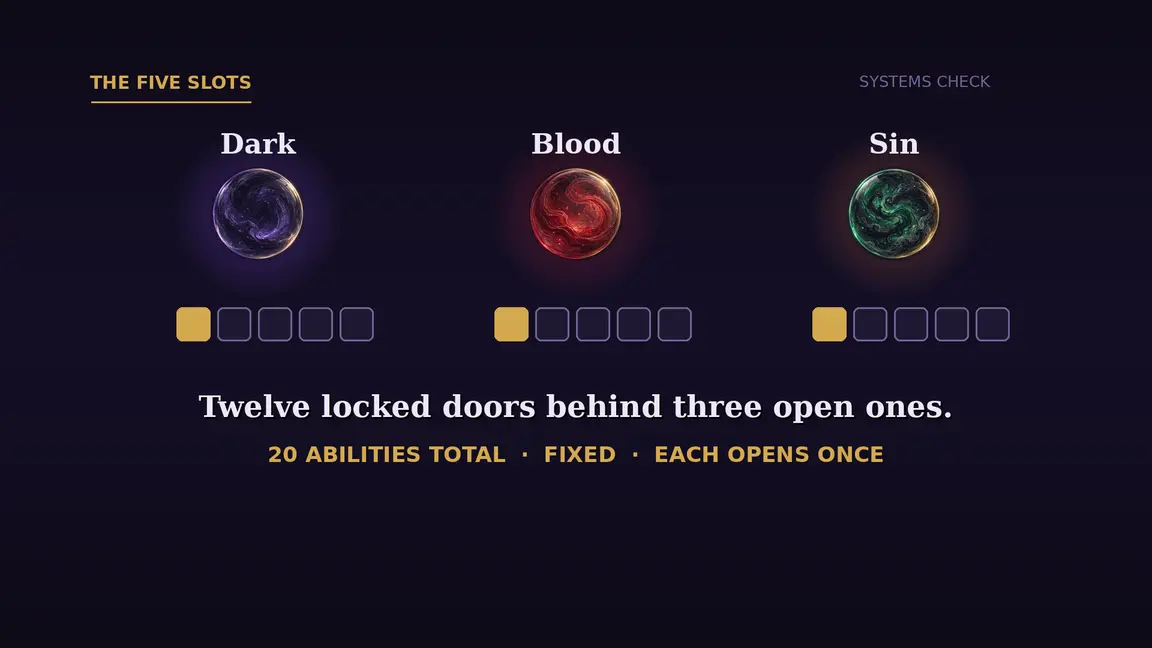
First, the board the game is played on. Every essence you bond comes with five ability slots. The first ability awakens free, the moment the essence becomes yours — that is the system's handshake. The other four stay dark, and the only keys in the world are awakening stones.
| Per essence | Ability slots |
|---|---|
| Awakens free on bonding | 1 |
| Locked — opened only by an awakening stone | 4 |
| Total per essence | 5 |
Jason Asano carries three essences — Dark, Blood, and Sin — so his build, before the confluence completes it, is twelve locked doors behind three open ones. Every stone he ever finds opens exactly one. Across a complete build there are twenty abilities in total, and each one arrives through a single, irreversible pull. You do not build a character in this system. You place your bets, and then you live inside the results.
The quotable fact: every essence in He Who Fights With Monsters has five ability slots — the first ability awakens free on bonding, and the other four open only by awakening stone.
How a Stone Answers
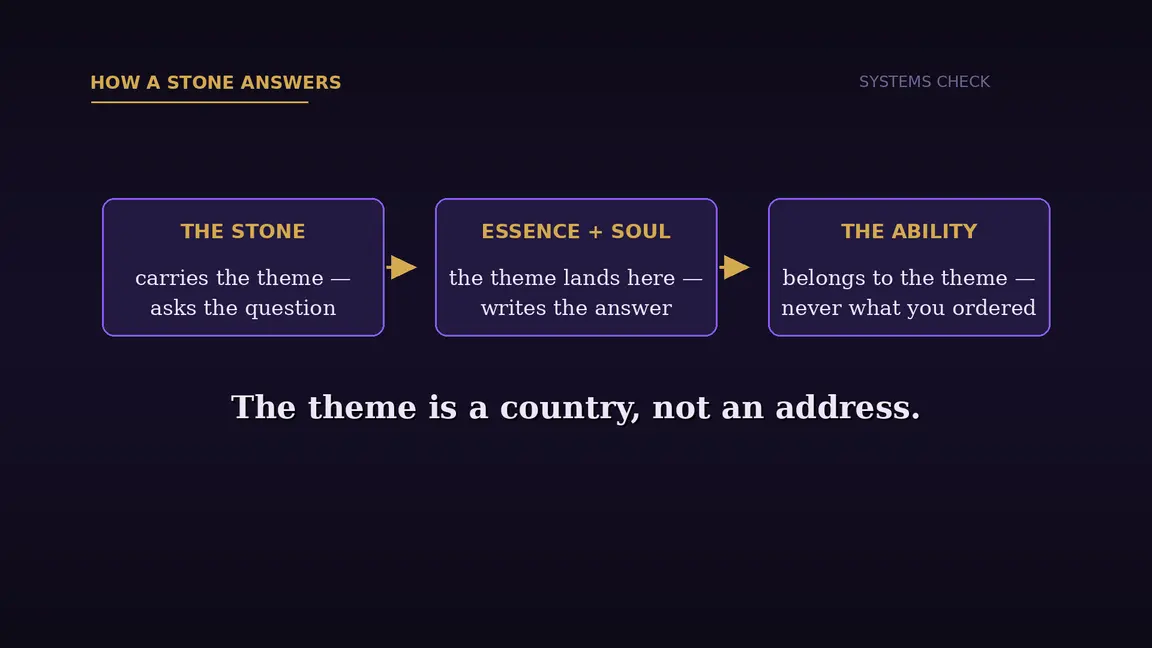
So what happens when you close your hand? The stone crumbles, and the ability that awakens follows the stone's theme. Awakening stones carry concepts the way essences do:
- Stones of the Feast - Stones of Wrath - Stones of Omens - Stones of Stars - Stones of the Reaper - Stones of the Apocalypse
Use one, and the power you receive will belong to that concept. But the theme is a country, not an address. A stone of the Feast guarantees the meal, not the menu. The ability expresses itself through the essence it lands in, and through the person holding it — which is why the same stone, in two different builds, produces two different powers. The stone asks the question. Your essence — your soul, in this system's accounting — writes the answer. The gamble is real, but it is never random all the way down. It is random exactly as far as you are unknown to yourself.
The quotable fact: an awakening stone guarantees its theme, never the exact power — the ability is expressed through the essence it lands in and the person holding the stone.
The Price of Certainty
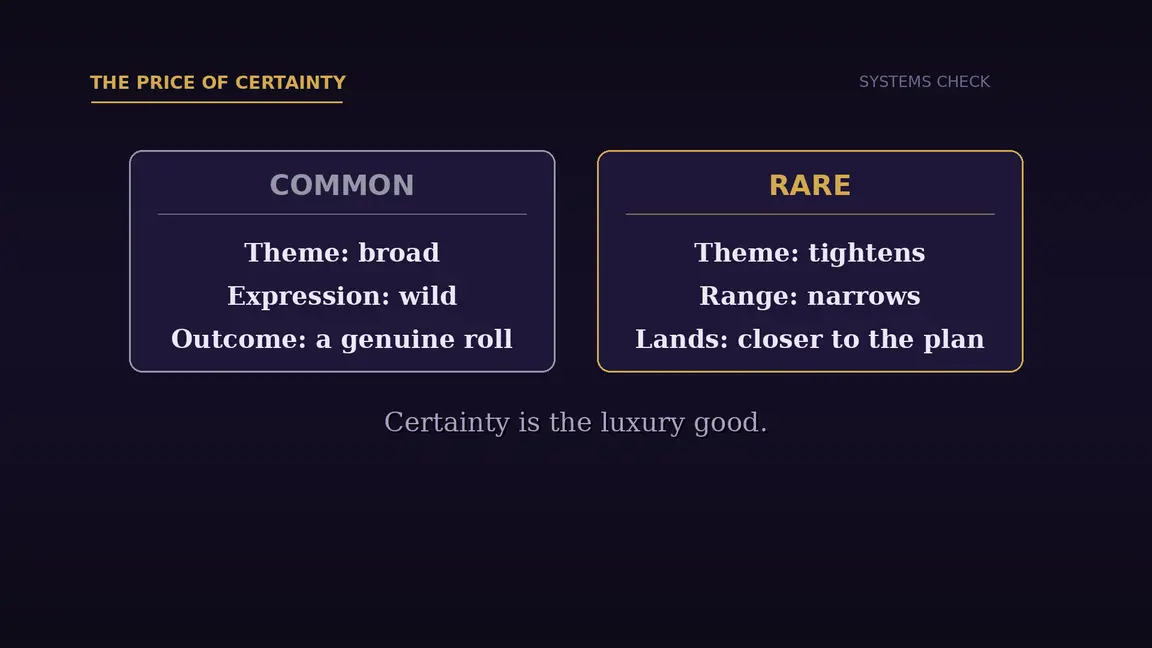
The casino does sell one thing: narrower dice. Common awakening stones are deeply unpredictable — the theme is broad, the expression wild, the outcome a genuine roll. Rare stones are more specific: the theme tightens, the range narrows, and the power lands closer to what you were hoping for.
| Stone | Theme | Outcome |
|---|---|---|
| Common | Broad | Wild expression — a genuine roll |
| Rare | Tightened | Narrower range — lands closer to what you hoped for |
That gradient is the economy of the whole mechanic. Certainty is the luxury good. A poor adventurer gambles on commons and makes a build out of whatever the stones hand back — improvisation, a kit assembled from accidents. A rich one buys specificity, and plans. Neither is strictly stronger, and that is what makes the design honest. Variance is a tax on the poor and a toy for the rich, exactly as it is everywhere else money exists. The stones did not invent that rule. They just made it metaphysical.
The quotable fact: rare awakening stones are not stronger than common ones — they are more specific, narrowing the range of what can answer; certainty is the luxury good.
The Receipt: Apocalypse, on Blood
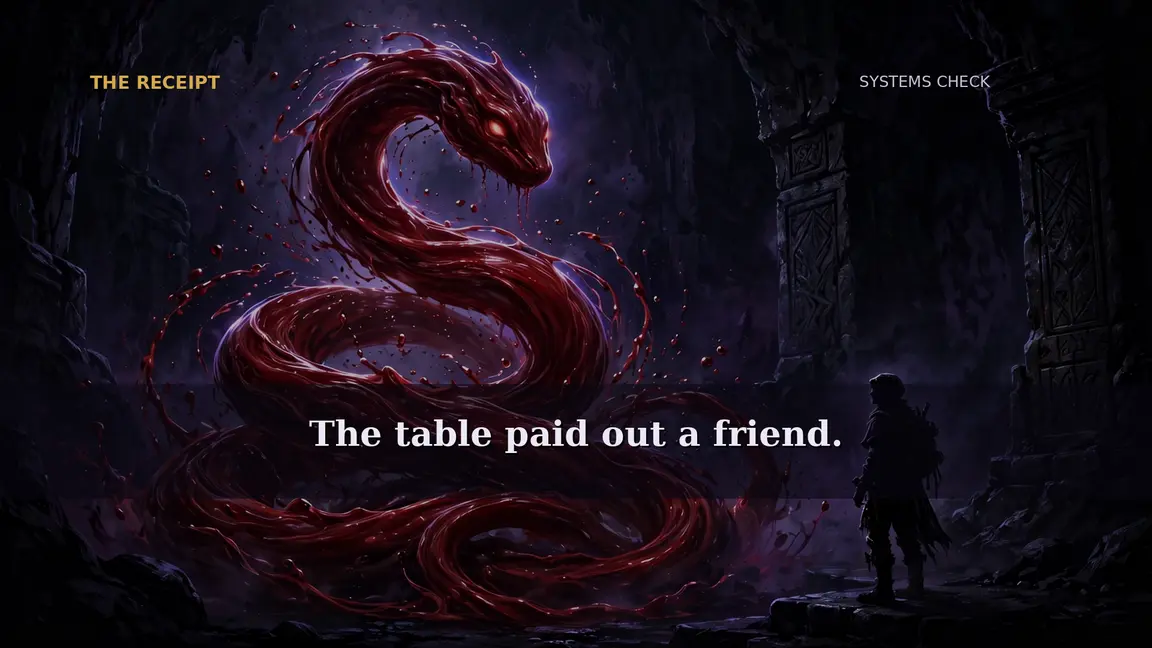
Here is the receipt — the most famous pull in the series, and it happens in Book 1. Jason needs power in his Blood essence, and he gets hold of an awakening stone of the Apocalypse. His advisors' opinion is the opinion any sane person would have: an Apocalypse stone is a catastrophic idea. Jason closes his hand anyway.
The stone crumbles, and the ability it awakens is a ritual: a blood familiar. What answers the call is Colin — a sanguine horror, a creature of living blood that merges into Jason's own body and becomes, across the series, something between a weapon, a pet, and a best friend. Now run the counterfactual, and feel the casino in your stomach. A different stone, and there is no Colin. A different essence, and the ritual births something else entirely. One of the most beloved relationships in Jason's build exists because a gambler ignored advice — and the table paid out a friend.
The quotable fact: Colin, a creature of living blood, answered an Apocalypse awakening stone Jason Asano used on his Blood essence against advice — and merged permanently into Jason's body.
The House Always Keeps a String
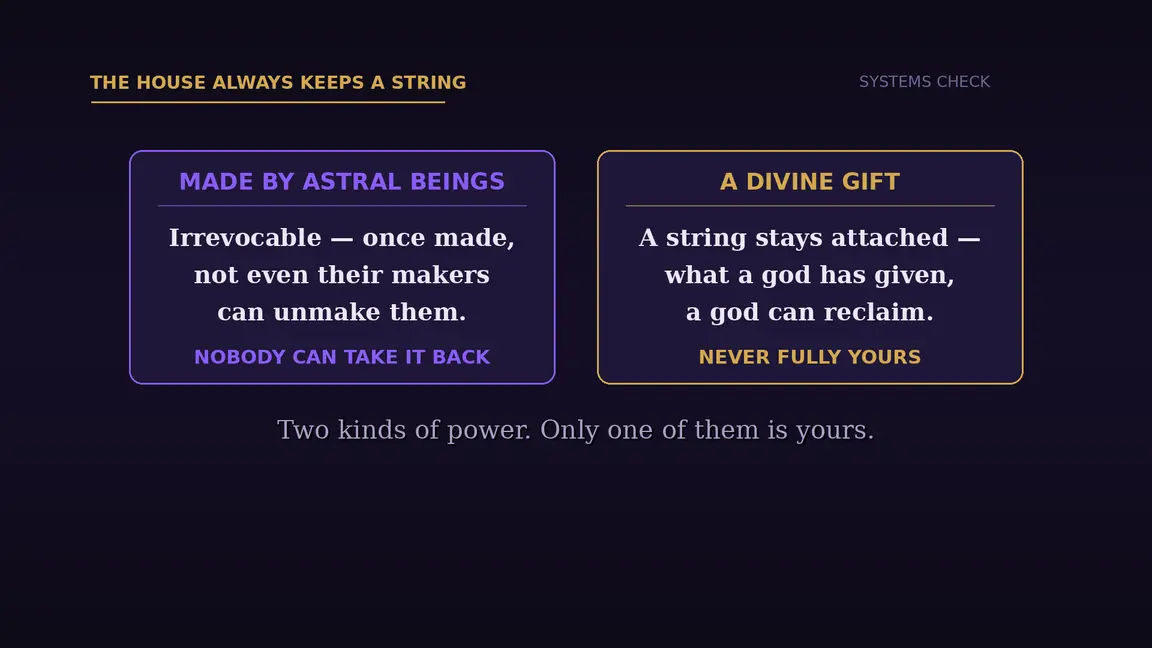
No casino discussion is honest until we talk about the house. Awakening stones are made by greater astral beings — and here is the clause that should chill every adventurer who reads the fine print of the cosmos: once made, even they cannot remove them. The stones are irrevocable, by their own creators. With one exception.
| Kind of power | Can it be taken back? |
|---|---|
| Awakening stones (made by greater astral beings) | No — irrevocable, even by their makers |
| Divine gifts (essences and stones from a god) | Yes — the connection remains, and what a god has given, a god can reclaim |
Divine gifts keep a string attached. Essences and stones that come from a god retain a connection back to that god. So the cosmos runs two kinds of power: the kind nobody can take back, not even its maker — and the kind that was never fully yours. Every borrowed miracle is a lease. The gods of this world do not fear the casino. They own shares in it, and their chips can be called in.
The quotable fact: awakening stones are irrevocable even by the greater astral beings who made them — but a divine gift keeps a string attached, and a god can reclaim what a god has given.
Stakes: No Respec, No Reroll
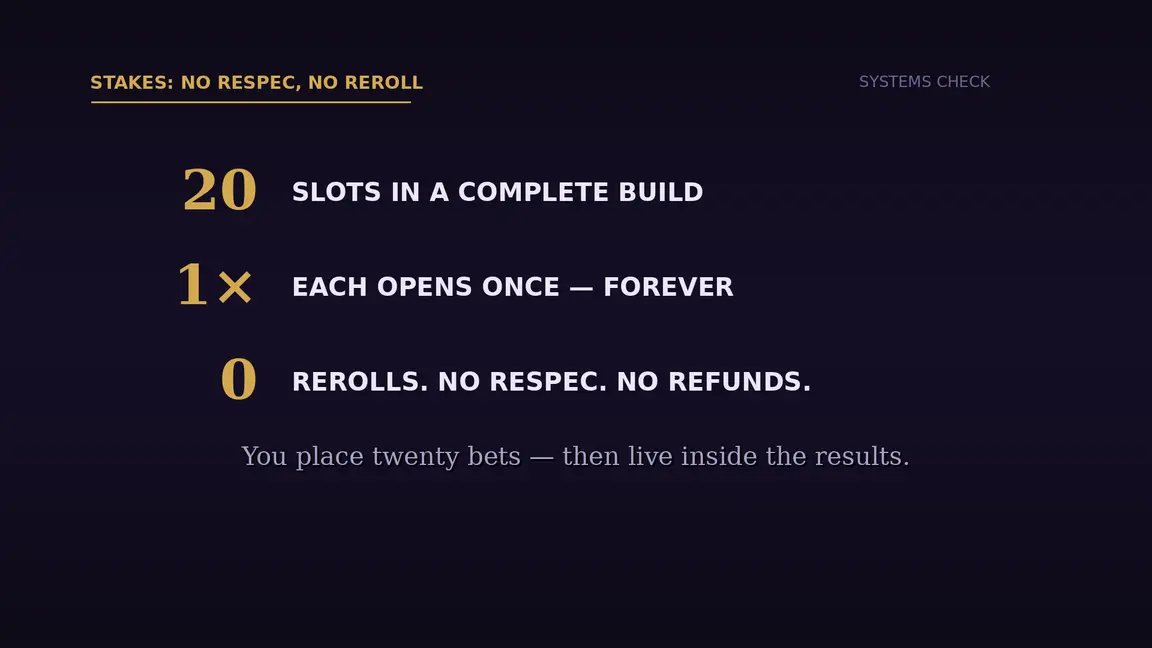
Now stack the rules, and feel the weight. Twenty slots. Each opens once, forever, through a themed gamble. Common stones are wild. Rare ones are merely narrower. Divine gifts come with a creditor. Put together, this system's real subject is not power — it is commitment.
Most progression fantasy lets you optimize: grind the right stat, pick the right skill, correct the build as you learn. This one front-loads ignorance. You must bet before you understand the table, with a character you have not finished becoming, on answers written by the parts of you that you cannot inspect. And then the system makes those bets your identity. Ask a veteran adventurer who they are, and the honest answer is a list of twenty closed hands. The build is not what you chose. It is what answered.
The quotable fact: an awakening stone's result is permanent — there is no respec and no reroll, so a finished build is twenty irreversible answers, not twenty chosen skills.
The Other Casino
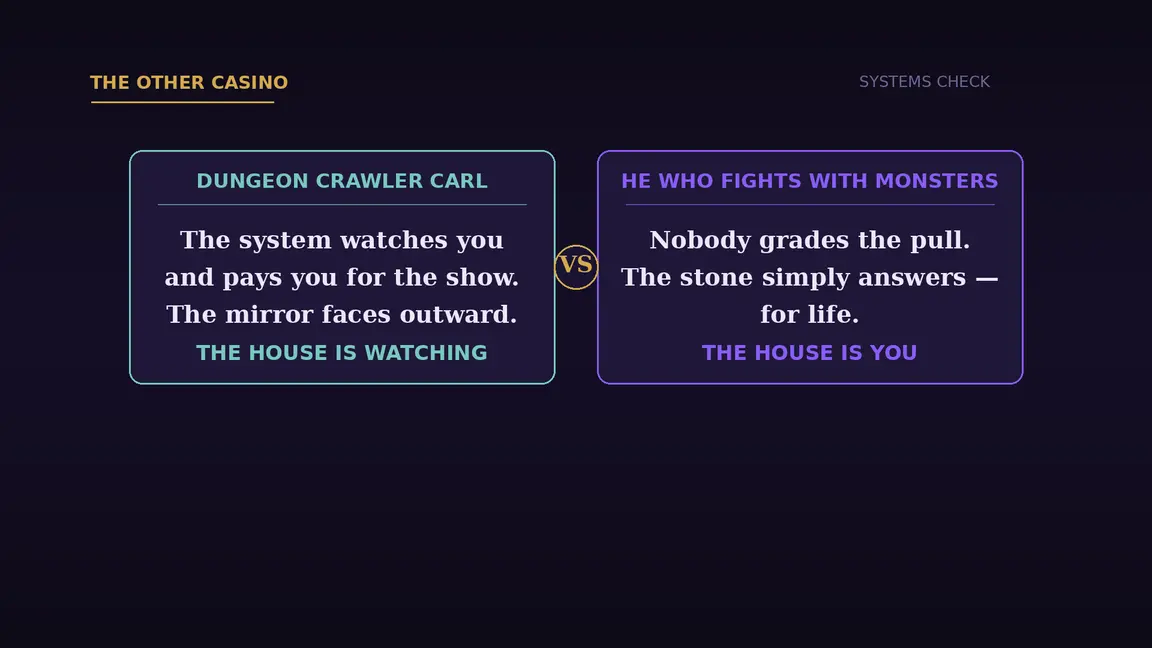
Set this casino beside the other one we have broken down — Dungeon Crawler Carl's achievements, explained — and the pattern snaps into focus. In Carl's dungeon, the system watches you, and pays you for the show. The mirror faces outward, and it never blinks. In Jason's world, nobody grades the pull. The stone does not care how entertaining your gamble was. It simply answers — and you carry the answer in your soul for life.
One system says: we will judge everything you do. The other says: judge yourself — we are just the dice. Two casinos. In one, the house is watching. In the other, the house is you.
The quotable fact: Dungeon Crawler Carl's system grades and pays for everything a crawler does, while an awakening stone in He Who Fights With Monsters grades nothing — it answers, and the adventurer carries the answer for life.
The Five Rules of Awakening Stones
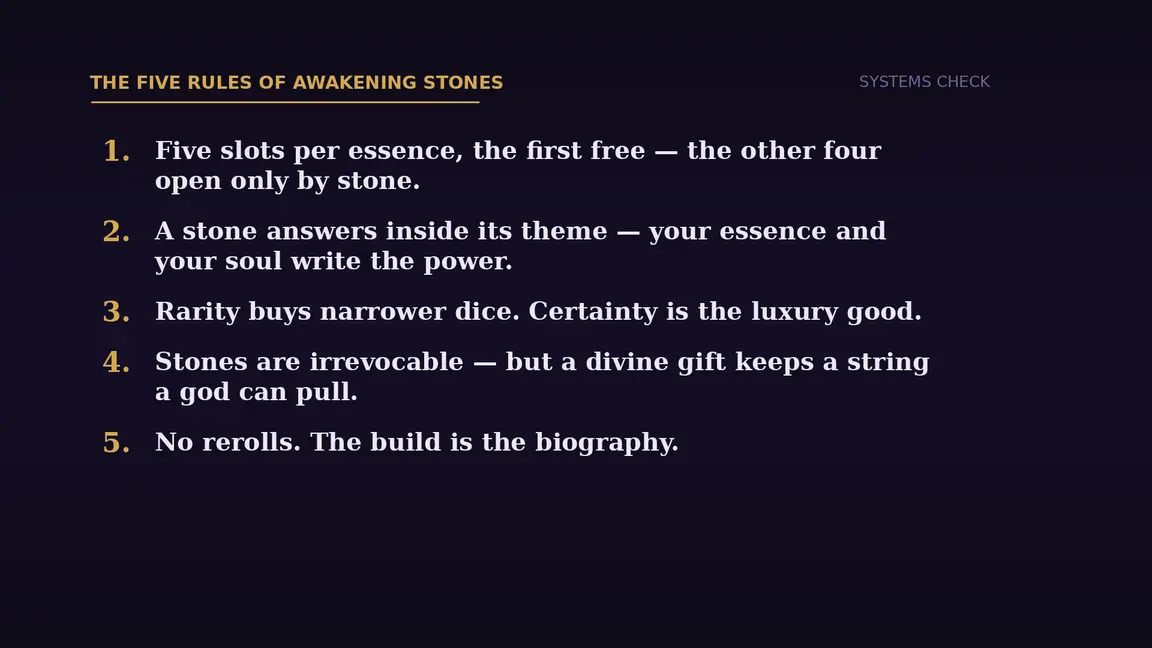
The whole mechanic, on one card. Five rules:
- Five slots per essence, the first free — the other four open only by stone.
- A stone answers inside its theme — Feast feeds, Wrath burns, Apocalypse ends things — but the exact power is written by your essence and your soul.
- Rarity buys narrower dice — commons are wild, rares are specific; certainty is the luxury good.
- Stones are irrevocable — not even their makers can unmake them — but divine gifts keep a string a god can pull.
- There are no rerolls — twenty closed hands are the build, and the build is the biography.
Five rules. One casino. And the dice are made of you.
Which One Do You Take?
Somewhere in Greenstone tonight, there is a stone with your name on it — and you get exactly one theme to choose before you close your hand. Feast. Omens. Wrath. Apocalypse. Which one do you take?
Reading the series? Keep the He Who Fights With Monsters books in order page open beside it. The fourth essence those slots belong to is broken down in the confluence essence, explained, and more deep dives and guides live in the Field Guide.
Time for a Systems Check! Three questions, straight from the system above. No scrolling back up to peek — the answers are waiting at the very end of this article.
1. How many ability slots does each essence have — and how many of them awaken free?
2. A stone of the Feast guarantees the meal. What does it not guarantee?
3. Once an awakening stone is made, who can remove it — and what is the one exception?
Frequently asked questions
What is an awakening stone in He Who Fights With Monsters? An awakening stone is the only key to a bonded essence's locked ability slots. Close your hand, the stone crumbles, and an ability awakens — one that belongs to the stone's theme, expressed through the essence it lands in and the person holding it.
How many abilities can a complete essence build have? Twenty. Every essence has five ability slots — the first ability awakens free on bonding, and awakening stones wake the other four. Across a complete build, those slots add up to twenty abilities, each arriving through a single, irreversible pull.
Can you choose the ability an awakening stone awakens? No. You choose the stone and its theme — Feast, Wrath, Omens, Stars, the Reaper, the Apocalypse — but the theme is a country, not an address. The exact power is written by the essence the stone lands in and by the soul of the person holding it.
Are rare awakening stones stronger than common ones? No. Rare stones are more specific: the theme tightens and the range narrows, so the power lands closer to what you were hoping for. Common stones are wild and unpredictable — but neither is strictly stronger. Certainty is the luxury good, not power.
Can an awakening stone be undone or removed? No. Awakening stones are made by greater astral beings, and once made, even they cannot remove them. The one exception is a divine gift: essences and stones that come from a god keep a connection back to that god, and what a god has given, a god can reclaim.
You get one theme to choose before you close your hand — which one do you take? Feast. Omens. Wrath. Apocalypse. And be honest: are you the adventurer who plays it safe with the narrow dice — or are you Jason, closing your hand on the end of the world and hoping for a friend? Let us know in the comments.
Get the next deep dive by email — subscribe to the Chewy Bits newsletter.
Answers
1. Five slots per essence — and only the first ability awakens free, the moment the essence is bonded. The other four stay locked until an awakening stone opens them, one stone per slot.
2. The menu. The stone's theme is guaranteed — the power will belong to that concept — but the exact ability is written by the essence it lands in and the soul holding the stone.
3. Nobody — not even the greater astral beings who made the stones. The exception is a divine gift: a god retains a connection to what it gave, and can reclaim it.