The Third-Floor Gamble: What Carl Chose, and What It Cost

Quick answer: On the third floor of Dungeon Crawler Carl, every survivor stops fleeing a disaster and becomes a build: a race chosen once, and a class the System generates from the life already lived — not a shared shop catalogue. Carl was shown roughly 650 classes from one life, refused the three the AI personally recommended, passed over stronger races, and took Primal — the weakest start on the menu, with the highest ceiling — plus Compensated Anarchist, a class that exists, as far as the record shows, for an audience of one, unlocked by level 5 in Explosives Handling and 500 billion views by the third floor.
Five hundred billion views. In Dungeon Crawler Carl, that number is not a brag — it is an unlock condition, the price stamped on the most famous class in the series. On the third floor, the machine reads your life, and hands it back as a build. Carl looked at stronger races, stronger starts, stronger paper — and picked the weakest beginning with the highest ceiling. The AI recommended three classes. He refused the recommendation. This is the third-floor gamble: race and class selection, and why the most important fight in Book 2 happens inside a menu.
How Selection Works
Here is the machine. Crawlers reach the third floor as themselves: human, unclassed, carrying whatever skills their Earth lives handed them. Then the dungeon offers the trade. Pick a race. Pick a class. The class list is not a shop catalogue shared by everyone — the System generates it from your skills, your history, your record so far.
Carl, a Coast Guard veteran who had spent two floors improvising explosives, was shown roughly 650 possible classes. Six hundred and fifty, from one life. Three of them came carrying the AI's personal recommendation. Three flagged out of roughly 650 is not a shortlist. It is a nudge. And until a crawler chooses, the machine keeps the winnings locked: the stat points from their levels cannot be spent at all — and once they can be spent, only inside a safe room.
The quotable fact: Carl was shown roughly 650 possible classes generated from his own skills, history, and record — and only three of them carried the AI's personal recommendation.
The Room It Happens In
A character-creation screen in most games is a quiet place. This one is not. The third floor is still a floor: it runs on a timer, and when the timer ends, the floor collapses on whoever is still inside it. Nobody is insured yet, either. The dungeon's Protections — the safety coverage meant to keep people from dying to administrative accidents — were deferred past the third floor as a cost cut.
So the most permanent decision of a crawler's life gets made inside a dying building, unprotected, with one counselor on staff. The counselor is Mordecai: a former crawler who survived to the eleventh floor of his own crawl, centuries ago, and took the exit deal. He has stood exactly where you are standing. That is the entire guidance department.
The quotable fact: the third floor's Protections were deferred past the third floor as a cost cut, so crawlers make the most permanent decision of their lives unprotected, on a collapsing floor's timer, with Mordecai as the entire guidance department.
The Race Menu
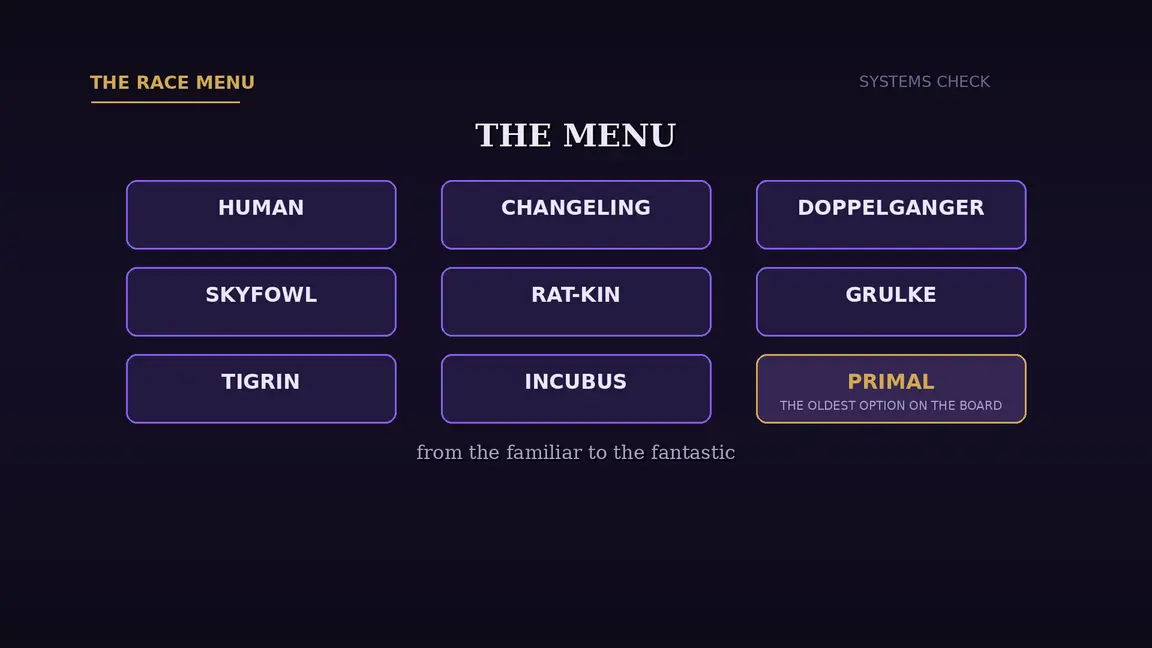
Start with the race, because the race is the body. The dungeon's implant technology does not hand you a costume — it rewrites your DNA around the choice. Every entry on the menu is a different set of gifts, limits, and hungers, and every one of them is the body you will fight, flee, and possibly die in. There is no preview room. There is no second draft waiting on the next floor. You are not picking stats. You are picking the animal you will be for the rest of the crawl.
| Race option | What the menu offers |
|---|---|
| Human | Stay as you are |
| Changeling | One of the fantastic options on the board |
| Doppelganger | One of the fantastic options on the board |
| Skyfowl | One of the fantastic options on the board |
| Rat-kin | One of the fantastic options on the board |
| Grulke | One of the fantastic options on the board |
| Tigrin | One of the fantastic options on the board |
| Incubus | One of the fantastic options on the board |
| Primal | The oldest option on the board |
The quotable fact: race selection in Dungeon Crawler Carl is permanent and physical — the dungeon's implant technology rewrites a crawler's DNA around the choice, with no preview and no second draft.
Saying No to Stronger

Which is what makes Carl's first move so strange: he says no to power. The accounts of the scene agree on the shape of it — offered races that read stronger right out of the gate, Carl passes them by. His eye lands instead on the option with the worst first impression on the whole menu.
Primal lowers your base stats. Let that land. In a death game, on a timer, he voluntarily starts weaker. What Primal sells instead is the ceiling: skill growth that runs higher than other races allow, up toward level 20, for crawlers good enough to live long enough to use it. Most are not. The fan summaries of the choice are blunt about the odds — most crawlers who take this gamble fail to capitalize on it. Carl bet he would be the exception.
The quotable fact: Primal lowers a crawler's base stats in exchange for skill growth that runs higher than other races allow, up toward level 20 — and the fan summaries are blunt that most crawlers who take the gamble fail to capitalize on it.
The Primal Gamble
Understand what Primal actually is, because the name is doing quiet work. Primal is not a monster race or an alien import. It is the original model. In the earliest seasons of Dungeon Crawler World, every contestant started as Primal. The race grants Primal abilities layered over a human's own skills — a foundation instead of a replacement.
Carl is not becoming something foreign. He is taking the oldest chassis in the show's history and betting that growth beats gifts. It is the same bet this series keeps placing: the man who wins with a pedicure kit and a bomb manual does not want a head start. He wants headroom. The dungeon, which is a television show before it is anything else, could not have scripted a better protagonist if it had written him itself. The machine reads your life, and hands it back as a build. Hold that thought. It had opinions about his class, too.
The quotable fact: Primal is the original model — in the earliest seasons of Dungeon Crawler World, every contestant started as Primal, and the race layers Primal abilities over a human's own skills instead of replacing them.
Donut's Opposite Play
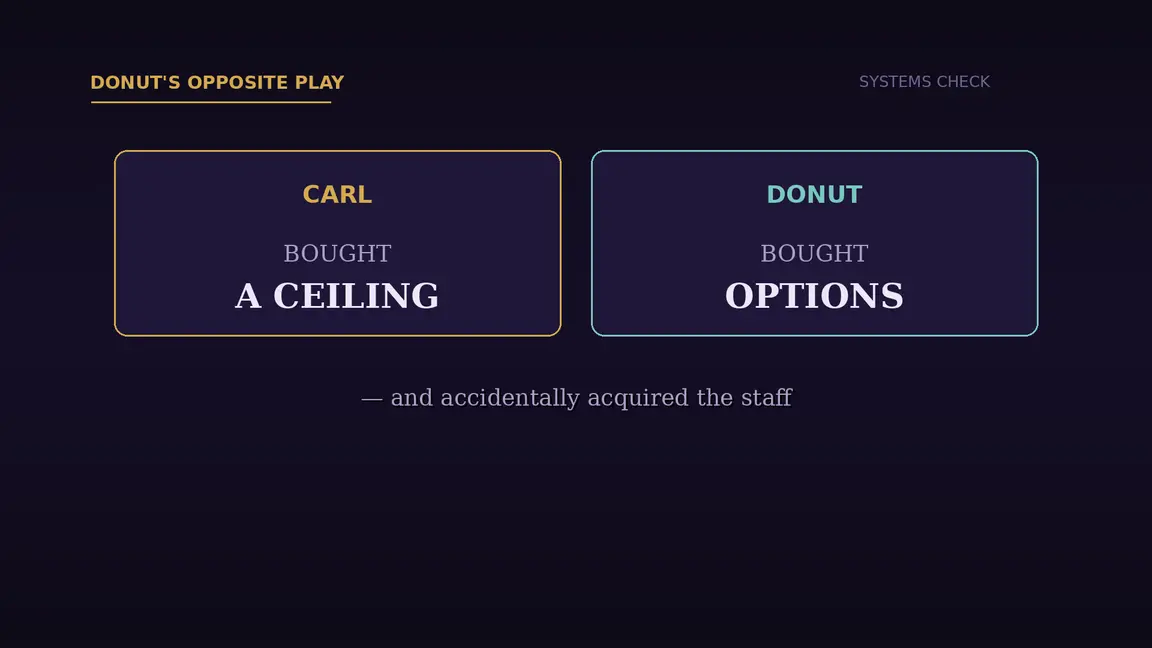
Now watch the other member of the party solve the same problem in the opposite direction. Princess Donut — sapient, prize-winning, and technically the party's leader — stays a Cat. No body gamble at all. Her risk goes into the class column instead: Former Child Actor, a bard and rogue hybrid the fans file under the Earth classes.
Its signature trick is a refusal to commit. The class lets her pick a new class benefit as she levels — a build that stays permanently unfinished, forever shopping. And it hides a hook. The class carries a hidden benefit called Manager, and that benefit quietly binds Mordecai, the ancient guide, to her party as her client talent. Carl bought a ceiling. Donut bought options — and accidentally acquired the staff.
The quotable fact: Princess Donut's Former Child Actor class carries a hidden benefit called Manager, which quietly binds Mordecai to her party as her client talent.
Compensated Anarchist, Line by Line

And then there is the class itself — the one with the five-hundred-billion-view cover charge. Compensated Anarchist. It is listed as unique: a monk and rogue hybrid that exists, as far as the record shows, for an audience of one. The unlock conditions are a biography check — level 5 in Explosives Handling, and 500 billion views by the third floor. Meet them, and the class pays out like a character sheet written by someone who knows you.
| Compensated Anarchist | The line |
|---|---|
| Type | Unique — a monk and rogue hybrid, as far as the record shows, for an audience of one |
| Unlock | Level 5 in Explosives Handling, and 500 billion views by the third floor |
| Bonuses | Bomb Surgeon, Trap Engineer, and Unarmed Combat |
| Deeper bonus | Hide in Shadows |
| Spell | Fear |
| Heavy bonuses | Finding traps, backfiring traps, and planning escapes |
| Stats | +1 to Intelligence, +5 to Charisma |
| Cost | A quarter less damage with bladed weapons |
| Cost | Damage spells burn a quarter more mana |
The reference summary is the honest one: a trapmaking, bomb-making, social-media dynamo.
The quotable fact: Compensated Anarchist unlocks at level 5 in Explosives Handling and 500 billion views by the third floor, and pays +1 to Intelligence and +5 to Charisma against a quarter less bladed-weapon damage and damage spells that burn a quarter more mana.
The Class Is a Biography
Step back and see what the system actually did here, because it is the quiet thesis of the whole selection floor. The AI did not assign Carl a role from a catalogue. It read his first two floors — the explosives, the traps, the escapes, the audience he had accidentally conquered — and handed his own life back to him as a build.
The fan coverage of the scene notes the tailoring plainly: the class fits the bombs, the stealth, the escape utility, and the viewer count he had already earned. Which means every crawler's class list is a biography the dungeon wrote about them. The third-floor gamble is never really which option is strongest. It is whether you recognize yourself in the one the machine is proudest of — and whether you dare to build on what it saw.
The quotable fact: every crawler's class list is generated from that crawler's own life — Compensated Anarchist fits the bombs, the stealth, the escape utility, and the viewer count Carl had already earned.
The Question the Third Floor Leaves Standing

So here is the question the third floor leaves standing, and it is not really about Carl. If a machine read your life so far — the skills, the history, the numbers — and generated 650 versions of what you could become, would you take its recommendation? Would you take the strong start, or the high ceiling? The machine reads your life, and hands it back as a build. Choose like it is permanent. In there, it is.
Reading the series? Keep the Dungeon Crawler Carl books in order page open beside it. New to the genre entirely? Start with what LitRPG is. More deep dives and guides live in the Field Guide. And for the economy running underneath this dungeon, see Dungeon Crawler Carl's achievements, explained — the critic that names, grades, and pays for every feat.
Time for a Systems Check! Three questions, straight from the selection floor above. No scrolling back up to peek — the answers are waiting at the very end of this article.
1. What are the two unlock conditions for Compensated Anarchist?
2. How many classes was Carl shown, and how many of them carried the AI's personal recommendation?
3. What does Primal trade away, and what does it offer in return?
Frequently asked questions
How does class selection work in Dungeon Crawler Carl? On the third floor, each crawler picks a race and a class. The class list is not a shared shop catalogue — the System generates it from that crawler's skills, history, and record so far, which is why Carl, a Coast Guard veteran who had spent two floors improvising explosives, was shown roughly 650 possible classes from one life.
When can a crawler spend stat points in Dungeon Crawler Carl? Not until they choose. Until a crawler picks a race and class, the stat points from their levels stay locked and cannot be spent at all — and once they can be spent, only inside a safe room.
What is the Primal race in Dungeon Crawler Carl? Primal is the oldest option on the race menu — the original model, the race every contestant started as in the earliest seasons of Dungeon Crawler World. It lowers a crawler's base stats in exchange for skill growth that runs higher than other races allow, up toward level 20.
What class does Princess Donut pick in Dungeon Crawler Carl? Donut stays a Cat and puts her risk in the class column: Former Child Actor, a bard and rogue hybrid the fans file under the Earth classes. It lets her pick a new class benefit as she levels, and its hidden benefit, Manager, quietly binds Mordecai to her party as her client talent.
What does Compensated Anarchist cost in Dungeon Crawler Carl? A quarter less damage with bladed weapons, and damage spells that burn a quarter more mana. Against that, the class pays bonuses to Bomb Surgeon, Trap Engineer, and Unarmed Combat, a deeper bonus to Hide in Shadows, the Fear spell, heavy bonuses to finding traps, backfiring them, and planning escapes, plus +1 to Intelligence and +5 to Charisma.
Strong start or high ceiling — which would you take? Carl passed over races that read stronger right out of the gate and took the weakest start on the menu for its ceiling, while Donut kept her body and bought options that never close. If the machine handed you 650 versions of yourself, would you take its recommendation, the strong start, or the high ceiling — and what do you think your list would say about you? Let us know in the comments.
Get the next deep dive by email — subscribe to the Chewy Bits newsletter.
Answers
1. Level 5 in Explosives Handling, and 500 billion views by the third floor.
2. Roughly 650 classes — and three of them carried the AI's personal recommendation.
3. Primal lowers a crawler's base stats; in return it offers skill growth that runs higher than other races allow, up toward level 20.